Someone is pitching you a $200/month SEO package right now. Maybe it’s a Fiverr seller. Maybe it’s an agency with a polished proposal. Either way, they’re selling tactics that could get your Google Business Profile suspended and your website buried — and they won’t be around to fix it.
Here’s what those tactics actually are, why they get sold, and what they cost you when they go wrong.
What it is: Bots that simulate GPS check-ins, map views, and driving directions to your business from different locations around your city. The idea is to trick Google into thinking real people are finding and engaging with your listing across a wider geographic area.
Why sellers pitch it: It’s automated, it’s cheap to run at scale, and the geo-grid ranking reports look convincing in a dashboard screenshot.
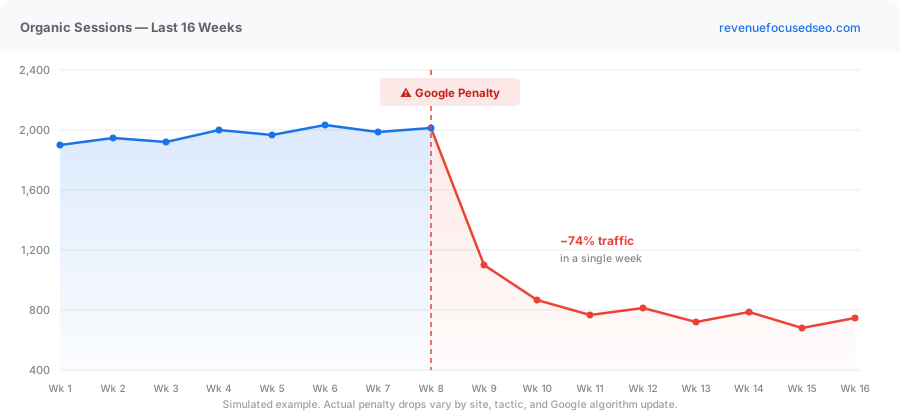
The real risk: Google’s spam detection has gotten significantly better at identifying non-human map engagement patterns. When it flags your listing, the result is usually a GBP suspension — not a warning, not a demotion, a full suspension. You disappear from Maps entirely. Reinstatement is a manual process that can take weeks or never happen at all.
Your Google Business Profile is your most valuable local SEO asset. It is not worth gambling on fake signals.
What it is: Bots that search your target keywords on Google, find your website or GBP listing, and click on it. The logic is that a higher click-through rate signals to Google that your result is relevant — so the bots fake that signal.
Why sellers pitch it: Google does use engagement signals. CTR is one of them. So the pitch sounds logical.
The real risk: Google cross-references clicks against behavioral patterns — device fingerprints, IP ranges, session depth, bounce behavior. Fake clicks don’t look like real user sessions, and they don’t read like local customers. When detected, you’re looking at ranking suppression or a manual action against your site. Either way, you lose ground you’ll spend months trying to recover.
What it is: A network of websites built specifically to sell backlinks. These sites have no real audience, no real content purpose, and no organic traffic. They exist to pass link equity — or the appearance of it — to paying clients.
Why sellers pitch it: Backlinks are a confirmed ranking factor. More links from authoritative-looking domains should mean better rankings. On paper, it makes sense.
The real risk: Google’s Penguin algorithm and manual spam reviewers have been targeting PBNs for over a decade. The patterns are well-documented: thin content, unnatural link velocity, footprints across hosting and domain registration. When Google devalues a PBN, every site that bought links from it takes a ranking hit simultaneously. There’s no warning. And if you get a manual penalty for unnatural links, recovering from it is expensive and slow.
What it is: Paying for backlinks delivered in small batches over time to avoid triggering obvious spam signals. Sellers frame it as “natural link building” because the links come in gradually instead of all at once.
Why sellers pitch it: The drip-feed framing sounds sophisticated. It sounds like they understand Google. It sounds safer.
The real risk: The links are still paid. The sites they come from are still part of a network built to sell links, not to create real content. Google’s guidelines are explicit: paying for links that pass PageRank is a violation, regardless of the delivery schedule. “Drip-fed” is a sales word, not a protection.
If the links don’t come from real editorial decisions by real publishers, they’re a liability sitting in your backlink profile.
What it is: A collection of Google-owned properties — Google Drive folders, Google Docs, Google Slides, Google Sites — stuffed with keyword-rich content and linked together to simulate authority signals. The pitch is that Google trusts its own properties, so Google will trust the stack.
Why sellers pitch it: It sounds clever. Using Google’s own infrastructure against itself has a certain logic to it, and it’s cheap to set up.
The real risk: Google Stacks have been discussed in SEO forums for years, which means Google has had years to identify and discount them. In practice, these stacks provide no meaningful ranking lift for competitive queries. What they do is waste your budget on setup and maintenance fees. For some businesses, sellers bundle them into packages where the stack is the main deliverable — meaning you paid for essentially nothing.
There are better places to put that money.
What it is: High-volume Google Business Profile post publishing (sometimes dozens per month) and bulk citation submissions to hundreds of directories, sold as packages starting at $5–$50.
Why sellers pitch it: Activity looks like progress. More citations and more posts seem like more SEO work being done.
The real risk: Bulk citation submissions often create duplicate listings with inconsistent NAP (name, address, phone) data across directories. Inconsistent NAP is a negative local ranking signal — you’re paying to make your local SEO worse. As for bulk GBP posts, spammy post activity can trigger spam flags on your listing, and low-quality posts signal nothing useful to Google or to actual customers who see them.
Quality and consistency matter. Volume without quality is noise.
None of this is a secret. The tactics that build durable local rankings are the same ones that require real effort — which is exactly why shortcuts keep getting sold.
Consistent, accurate citations. A smaller number of well-maintained citations on authoritative directories beats hundreds of inconsistent bulk submissions. Focus on the directories that matter in your industry and your city.
A fully optimized Google Business Profile. Complete every field. Use your real service area. Add genuine photos. Post consistently with content that has a point — offers, updates, FAQs. Respond to every review. This is the highest-leverage local SEO work you can do and most businesses do it poorly.
Content that answers real questions. Blog posts and service pages that address what your customers actually search before they call — treatment costs, timelines, comparisons, what to expect — build topical relevance that compounds over time.
Genuine backlinks. Local press, industry directories, sponsorships, partner links from real businesses. Harder to get. Worth far more.
These don’t come in a $200/month package because they require strategic thought and consistent execution. That’s the point.
If you want to know where your current site and GBP stand before spending another dollar on SEO, I offer a free site audit. No pitch deck, no inflated agency metrics — just a straight read on what’s working and what’s putting your rankings at risk.

Solo dev. Revenue-focused SEO consultant. Creator of SEO ContentSpy. Good governance advocate. Outside of work he loves freediving and goofing around with his wife and 2 kids.